Official Java SDK for AxonFlow - AI Governance Platform for Enterprise LLM Applications.



This SDK is a client library for interacting with a running AxonFlow control plane. It is used from application or agent code to send execution context, policies, and requests at runtime.
A deployed AxonFlow platform (self-hosted or cloud) is required for end-to-end AI governance. SDKs alone are not sufficient—the platform and SDKs are designed to be used together.
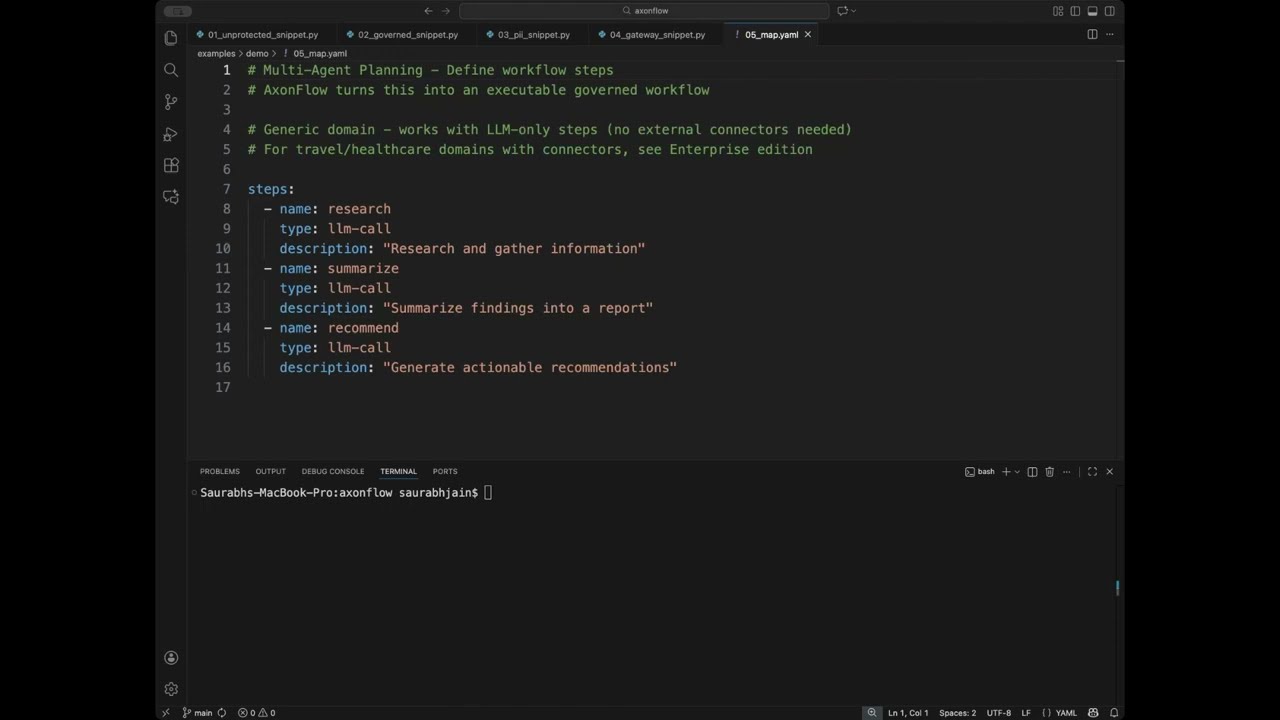
If you're new to AxonFlow, this short video shows how the control plane and SDKs work together in a real production setup:
- Java 11 or higher
- Maven 3.6+ or Gradle 6.0+
<dependency>
    <groupId>com.getaxonflow</groupId>
    <artifactId>axonflow-sdk</artifactId>
    <version>2.3.0</version>
</dependency>implementation 'com.getaxonflow:axonflow-sdk:2.3.0'Gateway mode provides the most control, allowing you to pre-check requests before making LLM calls:
import com.getaxonflow.sdk.AxonFlow;
import com.getaxonflow.sdk.AxonFlowConfig;
import com.getaxonflow.sdk.types.*;

public class GatewayExample {
    public static void main(String[] args) {
        // Initialize client
        AxonFlow client = AxonFlow.create(AxonFlowConfig.builder()
            .endpoint("https://agent.getaxonflow.com")
            .clientId("your-client-id")
            .clientSecret("your-client-secret")
            .build());

        // Step 1: Pre-check the request
        PolicyApproval approval = client.getPolicyApprovedContext(
            ClientRequest.builder()
                .userPrompt("What are the latest AI regulations?")
                .userId("user-123")
                .sessionId("session-456")
                .metadata(Map.of("source", "web-app"))
                .build()
        );

        // Step 2: Check if request is allowed
        if (approval.isAllowed()) {
            // Make your LLM call here
            String llmResponse = callYourLLM(approval.getModifiedPrompt());

            // Step 3: Audit the response
            ClientResponse response = client.auditLLMCall(
                AuditRequest.builder()
                    .requestId(approval.getRequestId())
                    .llmResponse(llmResponse)
                    .model("gpt-4")
                    .tokenUsage(TokenUsage.builder()
                        .promptTokens(150)
                        .completionTokens(200)
                        .totalTokens(350)
                        .build())
                    .latencyMs(450)
                    .build()
            );

            System.out.println("Response: " + response.getLlmResponse());
        } else {
            System.out.println("Request blocked: " + approval.getBlockedReason());
        }
    }
}
Proxy mode is simpler but provides less control - AxonFlow handles the LLM call:
import com.getaxonflow.sdk.AxonFlow;
import com.getaxonflow.sdk.AxonFlowConfig;
import com.getaxonflow.sdk.types.*;

public class ProxyExample {
    public static void main(String[] args) {
        AxonFlow client = AxonFlow.create(AxonFlowConfig.builder()
            .endpoint("https://agent.getaxonflow.com")
            .clientId("your-client-id")
            .clientSecret("your-client-secret")
            .build());

        ClientResponse response = client.executeQuery(
            ClientRequest.builder()
                .userPrompt("Summarize the key points of GDPR compliance")
                .userId("user-123")
                .model("gpt-4")
                .build()
        );

        if (response.isAllowed()) {
            System.out.println(response.getLlmResponse());
        } else {
            System.out.println("Blocked: " + response.getBlockedPolicyName());
        }
    }
}AxonFlowConfig config = AxonFlowConfig.builder()
.endpoint("https://agent.getaxonflow.com") // Required
.clientId("your-client-id")
.clientSecret("your-client-secret") // Required for cloud
.timeout(Duration.ofSeconds(30)) // Default: 60s
.debug(true) // Enable request logging
.insecureSkipVerify(false) // SSL verification (default: false)
.build();
AxonFlow client = AxonFlow.create(config);The SDK supports configuration via environment variables:
| Variable | Description |
|---|---|
AXONFLOW_AGENT_URL |
AxonFlow agent URL |
AXONFLOW_CLIENT_ID |
OAuth2 client ID for authentication |
AXONFLOW_CLIENT_SECRET |
OAuth2 client secret for authentication |
AXONFLOW_DEBUG |
Enable debug logging (true/false) |
| Method | Description |
|---|---|
getPolicyApprovedContext(request) |
Pre-check request against policies (Gateway Mode step 1) |
auditLLMCall(request) |
Audit LLM response (Gateway Mode step 2) |
executeQuery(request) |
Execute query through proxy (Proxy Mode) |
healthCheck() |
Check agent health status |
// Generate a plan
PlanRequest planRequest = PlanRequest.builder()
    .goal("Research and summarize AI regulations")
    .domain("legal")
    .userId("user-123")
    .maxSteps(5)
    .build();

PlanResponse plan = client.generatePlan(planRequest);

// Execute a plan step
StepExecutionRequest stepRequest = StepExecutionRequest.builder()
    .planId(plan.getPlanId())
    .stepIndex(0)
    .build();

StepExecutionResponse result = client.executeStep(stepRequest);

// Get plan status
PlanStatusResponse status = client.getPlanStatus(plan.getPlanId());// Query an MCP connector
MCPQueryRequest query = MCPQueryRequest.builder()
.connectorName("amadeus-flights")
.operation("search")
.parameters(Map.of(
"origin", "JFK",
"destination", "LAX",
"date", "2024-03-15"
))
.build();
MCPQueryResponse response = client.queryConnector(query);Exfiltration Detection - Prevent large-scale data extraction:
// Query with exfiltration limits (default: 10K rows, 10MB)
MCPQueryResponse response = client.queryConnector(query);

// Check exfiltration info
PolicyInfo.ExfiltrationCheck exCheck = response.getPolicyInfo().getExfiltrationCheck();
if (exCheck.isExceeded()) {
    System.out.println("Limit exceeded: " + exCheck.getLimitType());
    // LimitType: "rows" or "bytes"
}

// Configure: MCP_MAX_ROWS_PER_QUERY=1000, MCP_MAX_BYTES_PER_QUERY=5242880
Dynamic Policy Evaluation - Orchestrator-based rate limiting, budget controls:
// Response includes dynamic policy info when enabled
PolicyInfo.DynamicPolicyInfo dynamicInfo = response.getPolicyInfo().getDynamicPolicyInfo();
if (dynamicInfo.isOrchestratorReachable()) {
    System.out.println("Policies evaluated: " + dynamicInfo.getPoliciesEvaluated());
    for (PolicyMatch match : dynamicInfo.getMatchedPolicies()) {
        System.out.println("  " + match.getPolicyName() + ": " + match.getAction());
    }
}

// Enable: MCP_DYNAMIC_POLICIES_ENABLED=true// List policies
List<Policy> policies = client.listPolicies();
// Get specific policy
Policy policy = client.getPolicy("sql-injection-prevention");The SDK provides typed exceptions for different error scenarios:
try {
    PolicyApproval approval = client.getPolicyApprovedContext(request);
} catch (AxonFlowAuthenticationException e) {
    // Invalid or missing credentials
    System.err.println("Authentication failed: " + e.getMessage());
} catch (AxonFlowRateLimitException e) {
    // Rate limit exceeded
    System.err.println("Rate limited. Retry after: " + e.getRetryAfterSeconds() + "s");
} catch (AxonFlowValidationException e) {
    // Invalid request parameters
    System.err.println("Validation error: " + e.getMessage());
} catch (AxonFlowNetworkException e) {
    // Network/connectivity issues
    System.err.println("Network error: " + e.getMessage());
} catch (AxonFlowException e) {
    // Other SDK errors
    System.err.println("Error: " + e.getMessage());
}The SDK includes automatic retry with exponential backoff:
AxonFlowConfig config = AxonFlowConfig.builder()
    .endpoint("https://agent.getaxonflow.com")
    .clientId("your-client-id")
            .clientSecret("your-client-secret")
    .retryConfig(RetryConfig.builder()
        .maxAttempts(3)
        .initialDelayMs(100)
        .maxDelayMs(5000)
        .multiplier(2.0)
        .retryableStatusCodes(Set.of(429, 500, 502, 503, 504))
        .build())
.build();Enable caching for repeated policy checks:
AxonFlowConfig config = AxonFlowConfig.builder()
    .endpoint("https://agent.getaxonflow.com")
    .clientId("your-client-id")
            .clientSecret("your-client-secret")
    .cacheEnabled(true)
    .cacheTtl(Duration.ofMinutes(5))
    .cacheMaxSize(1000)
.build();The SDK provides interceptors for wrapping OpenAI and Anthropic API calls with automatic governance, enabling transparent policy enforcement without changing your application code.
import com.getaxonflow.sdk.AxonFlow;
import com.getaxonflow.sdk.AxonFlowConfig;
import com.getaxonflow.sdk.interceptors.*;

// Initialize AxonFlow client
AxonFlow axonflow = AxonFlow.create(AxonFlowConfig.builder()
    .endpoint("https://agent.getaxonflow.com")
    .clientId("your-client-id")
            .clientSecret("your-client-secret")
    .build());

// Create interceptor
OpenAIInterceptor interceptor = OpenAIInterceptor.builder()
    .axonflow(axonflow)
    .userToken("user-123")
    .asyncAudit(true)  // Fire-and-forget audit logging
    .build();

// Wrap your OpenAI call
ChatCompletionResponse response = interceptor.wrap(request -> {
    // Your actual OpenAI SDK call here
    return yourOpenAIClient.createChatCompletion(request);
}).apply(ChatCompletionRequest.builder()
    .model("gpt-4")
    .addUserMessage("Hello, world!")
    .temperature(0.7)
    .maxTokens(1024)
    .build());

// Or use the static wrapper for one-off calls
ChatCompletionResponse response = OpenAIInterceptor.wrapChatCompletion(
    axonflow,
    "user-123",
    request -> yourOpenAIClient.createChatCompletion(request)
).apply(request);import com.getaxonflow.sdk.interceptors.AnthropicInterceptor;
import com.getaxonflow.sdk.interceptors.AnthropicInterceptor.*;
// Create interceptor
AnthropicInterceptor interceptor = AnthropicInterceptor.builder()
.axonflow(axonflow)
.userToken("user-123")
.build();
// Wrap your Anthropic call
AnthropicResponse response = interceptor.wrap(request -> {
// Your actual Anthropic SDK call here
return yourAnthropicClient.createMessage(request);
}).apply(AnthropicRequest.builder()
.model("claude-3-sonnet-20240229")
.maxTokens(1024)
.system("You are a helpful assistant.")
.addUserMessage("Hello, Claude!")
.temperature(0.7)
.build());Both interceptors support async operations with CompletableFuture:
// Async OpenAI call
CompletableFuture<ChatCompletionResponse> future = interceptor.wrapAsync(
    request -> yourOpenAIClient.createChatCompletionAsync(request)
).apply(request);

future.thenAccept(response -> {
    System.out.println("Response: " + response.getContent());
});When a request is blocked by policy, the interceptor throws a PolicyViolationException:
try {
    ChatCompletionResponse response = interceptor.wrap(openaiCall).apply(request);
} catch (PolicyViolationException e) {
    System.err.println("Blocked by policy: " + e.getPolicyName());
    System.err.println("Reason: " + e.getBlockReason());
}The AxonFlow client is thread-safe and designed for reuse. Create a single instance and share it across your application:
// Create once at application startup
AxonFlow client = AxonFlow.create(config);

// Reuse across threads
executorService.submit(() -> client.executeQuery(request1));
executorService.submit(() -> client.executeQuery(request2));The SDK uses SLF4J for logging. Add your preferred logging implementation:
<!-- Logback -->
<dependency>
    <groupId>ch.qos.logback</groupId>
    <artifactId>logback-classic</artifactId>
    <version>1.4.14</version>
</dependency>
Enable debug logging for request/response details:
AxonFlowConfig config = AxonFlowConfig.builder()
    .endpoint("https://agent.getaxonflow.com")
    .debug(true)
.build();See our Spring Boot Integration Guide for:
- Auto-configuration
- Spring Security integration
- Request interceptors
- Health indicators
Complete working examples for all features are available in the examples folder.
// PII Detection - Automatically detect sensitive data
PolicyApproval result = client.getPolicyApprovedContext(
    ClientRequest.builder()
        .userPrompt("My SSN is 123-45-6789")
        .userId("user-123")
        .build()
);
// result.isAllowed() = true, result.requiresRedaction() = true (SSN detected)

// SQL Injection Detection - Block malicious queries
PolicyApproval result = client.getPolicyApprovedContext(
    ClientRequest.builder()
        .userPrompt("SELECT * FROM users; DROP TABLE users;")
        .userId("user-123")
        .build()
);
// result.isAllowed() = false, result.getBlockedReason() = "SQL injection detected"

// Static Policies - List and manage built-in policies
List<Policy> policies = client.listPolicies();
// Returns: [Policy{name="pii-detection", enabled=true}, ...]

// Dynamic Policies - Create runtime policies
client.createDynamicPolicy(DynamicPolicyRequest.builder()
    .name("block-competitor-queries")
    .conditions(Map.of("contains", List.of("competitor", "pricing")))
    .action("block")
    .build());

// MCP Connectors - Query external data sources
MCPQueryResponse resp = client.queryConnector(MCPQueryRequest.builder()
    .connectorName("postgres-db")
    .operation("query")
    .parameters(Map.of("sql", "SELECT name FROM customers"))
    .build());

// Multi-Agent Planning - Orchestrate complex workflows
PlanResponse plan = client.generatePlan(PlanRequest.builder()
    .goal("Research AI governance regulations")
    .domain("legal")
    .build());
StepExecutionResponse result = client.executePlan(plan.getPlanId());

// Audit Logging - Track all LLM interactions
client.auditLLMCall(AuditRequest.builder()
    .requestId(approval.getRequestId())
    .llmResponse(llmResponse)
    .model("gpt-4")
    .tokenUsage(TokenUsage.builder()
        .promptTokens(100)
        .completionTokens(200)
        .totalTokens(300)
        .build())
    .latencyMs(450)
.build());These features require an AxonFlow Enterprise license:
// Code Governance - Automated PR reviews with AI
PRReviewResponse prResult = client.reviewPullRequest(PRReviewRequest.builder()
    .repoOwner("your-org")
    .repoName("your-repo")
    .prNumber(123)
    .checkTypes(List.of("security", "style", "performance"))
    .build());

// Cost Controls - Budget management for LLM usage
Budget budget = client.getBudget("team-engineering");
// Returns: Budget{limit=1000.00, used=234.56, remaining=765.44}

// MCP Policy Enforcement - Automatic PII redaction in connector responses
MCPQueryResponse resp = client.queryConnector(query);
// resp.getPolicyInfo().isRedacted() = true
// resp.getPolicyInfo().getRedactedFields() = ["ssn", "credit_card"]
For enterprise features, contact sales@getaxonflow.com.
We welcome contributions. Please see our Contributing Guide for details.
This SDK is licensed under the Apache License 2.0.
- Documentation: https://docs.getaxonflow.com
- Issues: https://github.com/getaxonflow/axonflow-sdk-java/issues
- Email: dev@getaxonflow.com
